  Consumers for broadband services around the globe are seen to make their choice of service provider for the services on two factors, price and speed.
"If you want to convince the average customer they should take your broadband service over the competition you have two primary selling points, price and speed,” says Oliver Johnson, CEO at Point Topic. “If we look at the ‘entry level’ services on offer in these terms we can start to make some direct comparisons.”
The research by Point Topic for broadband services around the globe for Q2 2009, highlights that globally entry level price points are leveling off but currently consumers are getting more for the price paid.
Fig.1 Entry level price per megabit by technology in USD
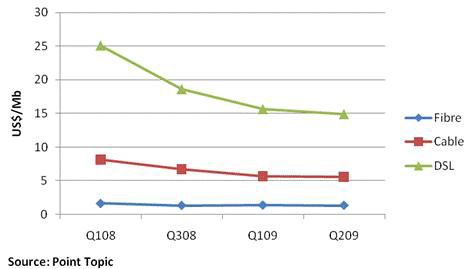
Pressure will be on DSL and cable medium to offer more as they face increasing challenge from fibre. And they have been able to do so reasonably well with residential consumers paying 40% less than for DSL-based services and 30 % less for cable-based services when compared to a year ago period. Fibre prices have dropped by only 17 % during the period.
“Fibre has such an advantage over the other delivery technologies that those operators don’t have to worry much about DSL and cable as competitors, at least for the moment,” says Johnson adding that ultimately it will be hybrid solutions which will come in handy for the service providers.
Speed-wise, Cable-based service providers have increased their offering by 21 % in 18 months while Fibre-based operators have increased by 15 % and DSL-based by 17%.
Fig.2 Entry level headline speeds world average by technology
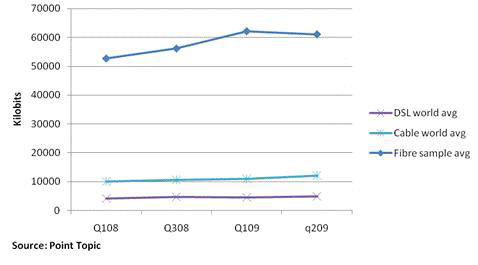
“New technology roll outs for both DSL and cable, primarily ADSL2+ and DOCSIS 3.0, allows operators to boost their speeds and they’ve done so proportionally more than those offering fibre,” says Johnson.
Cable operators are also believed to be gaining advantage with the new DOCSIS 3.0 standard. For instance UK’s Virgin Media which has upgraded to the standard now offers 50 Mbps for $ 80 per month. BT which has implemented FTTC will be able to offer 40 Mbps.
|