|
||||

Home | News | Career
Catalyst | Newsletter | Conclave | Advertise | Newsletter | Conclave | Advertise
|
||||||
|
Great Achievements in a Small World ——An Analysis of WiMAX Indoor Coverage Solution By Liu Min Indoor coverage is the main battlefield for high density and differentiation among operators, especially for WiMAX. On the one hand, because of the spectrum characteristics of WiMAX, where currently in the world, major spectrums of WiMAX include As seen from the experience of mobile operators’ I. Technological innovation tackling the traditional difficultyWiMAX is a TDD system. For indoor coverage, the first step is to acquire time
synchronization. Traditional GPS solution, due to
the restriction and high cost of telecom construction, as well as the difficulty in GPS antenna feeder layout, has very limited
applications. Facing the difficulty to acquire time synchronization, ZTE creatively proposed two solutions, namely, using ToP technology
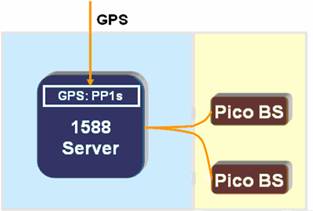
or high sensitivity GPS, for indoor Pico BS/Femto. Based on IEEE1588 protocol, ToP technology can solve indoor GPS antenna installation and indoor coverage problems through packet network
transmission and clock synchronization recovery. Besides, ZTE ToP server can
also intelligently adjust the parameters of ToP algorithm according to the characteristics of different transmission mediums, so as to better satisfy WiMAX network synchronizations requirements. ZTE is the first vendor supporting IEEE1588 time synchronization
solution on commercial base
stations. ToP server can support GPS signal provision and distribution upon regional coverage.
Figure 1 Working mode
of IEEE1588 server In case of the sporadic deployment of Pico
BS/Femto, high precision indoor GPS scheme can be used for time synchronization. The receiving
sensitivity of high sensitivity GPS receiver can reach -160 dBm.
Therefore,
using indoor GPS antenna can ensure that the synchronized signals outputted from GPS can meet WiMAX system requirements, while a normal GPS receiver has a receiving sensitivity of only -143 dBm, requiring outdoor GPS antenna to secure its performance. In addition, ZTE’s Pico BS for indoor
coverage can support flexible subcarrier distribution and networking mode, FFR technology, adjacent signal measurement as well as frequency
justification and optimization to minimize the interference in indoor coverage. These enhanced technologies effectively remedy the inherent deficiency of indoor conditions and
bring great gain to
coverage performance. II. Adjustable solutions, rapid profit-makingThe second difficulty faced by indoor coverage is how to solve the backhaul problem of R6 interface, and provide a cost-effective and fast deployment solution. Existing indoor transmission resources have two features: diversity and limitedness.
Different operators have different indoor transmission resources, but to a specific application, the resource is mostly limited. For a fixed network operator, Ethernet or optical fiber resources are normally available in the building; for a cable operator, normally only cable resources are available in the building; for
an emerging operator, wired resources are largely unavailable within the last mile, so as in the building; for a traditional For the difficulties mentioned above, ZTE has given a flexible and fast solution. For fixed network and cable operators, they can make
the most of existing DSL, Ethernet, optical
fiber and cable resources,
with equipment directly integrating corresponding transmission interfaces thus achieving flexible deployment and capacity expansion. For some historical buildings or those that do not allow wall
penetrating and rewiring, ZTE uses broadband power line (BPL) technology where
ubiquitous power lines are used as plug-and-play
transmission media, remarkably shortening network
construction period, reducing construction cost, and allowing the operator to make profit rapidly. Besides the
reduction of OPEX in the initial networking period, ZTE also helps the WiMAX
operator to effectively reduce CAPEX through unified
network management and
charging. III. Success stories in the high-end marketKT in The world’s first WiMAX commercial network by
Sprint-Clearwire, a top operator in A major operator in Due to the
characteristics of WiMAX technology and service, WiMAX network is totally different from ZTE is willing to work with operators to technically break the restriction of traditional indoor deployment, and use
feasible engineering deployment schemes to reduce indoor
coverage cost, expedite networking and help operators to get ‘maximum’
success in ‘small’ indoor coverage world. |
||
| Note: The above content is 'Advertorial' from ZTE Corp. |
| About Us | Advertise | Contact Us | Feedback |
| Copyright @ AT Data Process Pvt. Ltd 2007-2009 Terms of use |
| This site is best viewed in Internet Explorer 6.0 and higher versions, at a resolution of 1024 x 768 pixels |